

How Do You Choose the Right Ayurvedic Hair Oil for the UAE Climate?
Living in the UAE offers a great lifestyle, but the climate can be challenging for your hair. Many people who move here—or have lived here for years—notice increased hair fall, dryness, dandruff, rough hair, or loss of shine. While changing shampoos is often the first reaction, the real solution may lie in understanding your hair, your scalp, and choosing the right Ayurvedic hair oil.
The truth is simple: there is no single hair oil that suits everyone. The best choice depends on your hair type, scalp condition, and the environment you live in.
Why the UAE Climate Demands Special Hair Care
Think about your daily routine.
You leave home and face intense heat. Within minutes, you’re inside an air-conditioned office where your hair and scalp are exposed to dry air for several hours. As you move between indoors and outdoors, your hair is constantly exposed to heat, humidity and dust. At the end of the day, you wash your hair with hard water, which may leave mineral deposits on the hair over time.
This cycle repeats itself almost every day.
Over time, these conditions can affect both your scalp and your hair, leading to:
- Increased hair fall
- Dry or brittle hair
- Frizzy and unmanageable hair
- Itchy or uncomfortable scalp
- Dandruff
- Loss of natural shine
The solution is not simply applying more hair oil. The key is choosing an Ayurvedic formulation that suits your hair and scalp.
Understand Your Hair Before Choosing a Hair Oil
One of the most common mistakes people make is choosing hair oil based only on advertisements or recommendations from friends. Hair care is personal. What works well for one person may not work for another.
Before selecting a hair oil, consider both your hair texture and your scalp condition.
Hair Texture
Fine or Thin Hair
Fine hair becomes oily quickly. Heavy oils may weigh it down and make it look greasy. A lightweight Ayurvedic formulation that absorbs easily is usually a better choice.
Dry, Rough or Chemically Treated Hair
Dry hair needs nourishment rather than just surface coating. Look for oils containing traditional Ayurvedic ingredients known for their conditioning properties, such as Coconut Oil, Amla, Hibiscus and Aloe Vera.
Curly or Frizzy Hair
Curly hair naturally loses moisture more easily than straight hair. Regular oiling helps improve manageability while reducing dryness and frizz.
Straight Hair
Straight hair distributes natural scalp oils more effectively. Using an extremely heavy oil may not always be necessary unless the scalp itself is dry.
Your Scalp Deserves Equal Attention
Healthy hair begins with a healthy scalp.
Many people focus only on the hair strands while ignoring the scalp, where healthy hair actually grows.
Dry Scalp
A dry scalp benefits from nourishing herbal oils that help maintain moisture and comfort.
Oily Scalp
People with oily scalps should avoid excessively heavy oils and instead choose lighter formulations that nourish without leaving a greasy feeling.
Dandruff-Prone Scalp
Instead of simply trying to hide flakes, look for Ayurvedic ingredients traditionally used to support scalp health.
Sensitive Scalp
If your scalp becomes irritated easily, choose products that are free from unnecessary additives such as mineral oil, artificial colours and preservatives.
Don’t Buy Hair Oil Without Reading the Ingredients
The quality of an Ayurvedic hair oil lies in its formulation.
Rather than choosing a product based only on attractive packaging or marketing claims, take a moment to read the ingredient list.
Some of the traditional Ayurvedic ingredients widely valued for hair care include:
- Bhringaraj – Traditionally known in Ayurveda for supporting healthy hair.
- Amla – Rich in natural antioxidants and commonly used to strengthen hair.
- Coconut Oil – Helps nourish both the scalp and hair.
- Aloe Vera – Helps soothe dryness and improve scalp comfort.
- Fenugreek – Traditionally used to improve hair texture and softness.
When these ingredients are combined using Ayurvedic principles, they work together to support overall scalp and hair health.
Common Mistakes People Make While Oiling Their Hair
Even a good hair oil may not deliver the expected results if it is used incorrectly.
Some common mistakes include:
- Applying excessive amounts of oil.
- Leaving oil on the scalp for several days.
- Using very heavy oils on naturally oily scalps.
- Frequently changing hair oils without giving them enough time to work.
- Ignoring scalp health and focusing only on the hair length.
Consistency is usually more important than applying large quantities.
How Often Should You Oil Your Hair?
There is no universal formula. Your hair type should determine how frequently you oil your hair.
| Hair Type | Recommended Frequency |
| Dry or Rough Hair | 2–3 times per week |
| Curly or Frizzy Hair | About twice a week |
| Oily Scalp | Once every 7–10 days |
| Normal Hair | Once a week |
| Dandruff-Prone Scalp | Once a week before shampooing |
Massage the oil gently into the scalp using your fingertips and leave it on for a reasonable period before washing.
A Practical Checklist Before Buying Any Ayurvedic Hair Oil
Instead of asking,
“Which brand is the best?”
Ask yourself:
- Does it suit my hair type?
- Is it suitable for my scalp condition?
- Does it contain traditional Ayurvedic herbs?
- Is it free from unnecessary mineral oil, artificial colours and preservatives?
- Does it follow Ayurvedic principles rather than simply adding one or two herbal extracts?
Answering these questions will help you make a more informed choice.
Where Does Dhathri Hair Care Plus Herbal Oil Fit In?
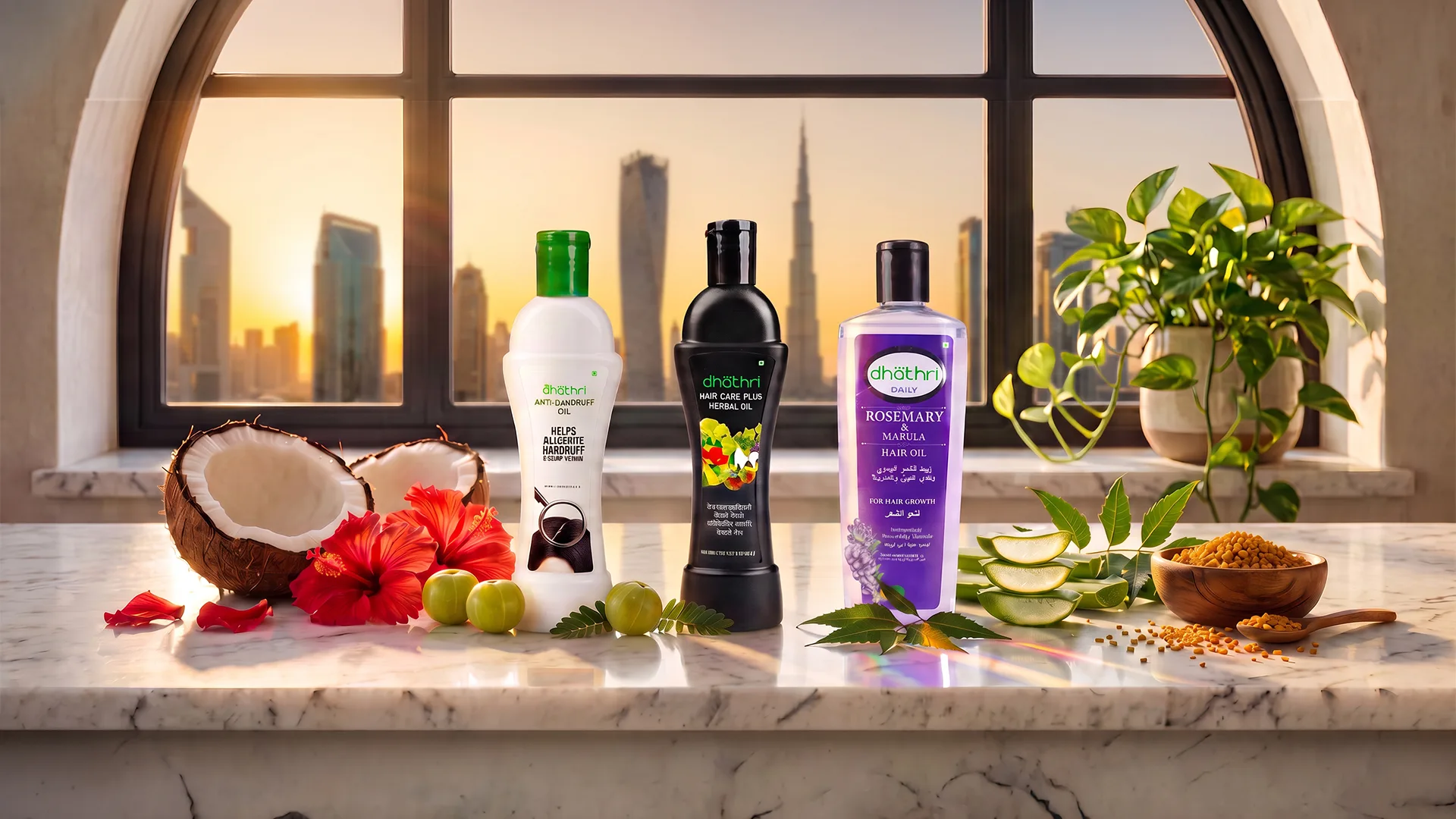
If you are looking for an Ayurvedic hair oil suitable for the demanding UAE climate, Dhathri Hair Care Plus Herbal Oil is one option worth considering.
The formulation combines several traditional Ayurvedic herbs, including Bhringaraj, Amla, Coconut Oil, Aloe Vera, Fenugreek and other carefully selected plant-based ingredients that have been valued in Ayurvedic hair care for generations.
The product is also free from mineral oil, artificial colours and preservatives, making it suitable for people who prefer a more traditional Ayurvedic approach to hair care.
Rather than simply coating the hair, the formulation is designed to nourish the scalp and support healthier-looking hair from the roots.
Final Thoughts
Choosing the right Ayurvedic hair oil is not about selecting the most expensive or the most popular brand. It is about finding a formulation that matches your hair type, scalp condition and daily environment.
In the UAE, where intense heat, humidity, dust, hard water and prolonged exposure to air conditioning are part of everyday life, your hair faces challenges that require thoughtful care.
When selecting an Ayurvedic hair oil, pay attention to the ingredients, the formulation and whether it suits your individual needs.
If you choose a product based on these factors rather than marketing claims alone, you are already taking the right step towards healthier hair.
Frequently Asked Questions (FAQs)
People with dry or rough hair should look for formulations containing nourishing Ayurvedic ingredients such as Coconut Oil, Amla, Hibiscus and Aloe Vera, which help improve softness and manageability.
Yes. People with oily scalps can still benefit from hair oiling by choosing lightweight Ayurvedic formulations and using them less frequently than those with dry hair.
There is no fixed rule. Most people find that once or twice a week before shampooing works well, but the ideal frequency depends on your hair type and scalp condition.
Yes. Applying Ayurvedic hair oil before shampooing allows the herbal ingredients time to nourish the scalp and hair before cleansing.
Hard water does not directly cause hair loss, but mineral deposits can make hair feel dry, rough and difficult to manage. Using a suitable hair care routine, including an appropriate Ayurvedic hair oil, can help maintain healthier-looking hair.